Evidence-Based Sports Supplements That Improve Performance
A Practical Guide to Matching Ergogenic Aids to the Demands of Your Sport
A practical overview of the supplements with the strongest evidence for improving sports performance, and how to match them to the key performance limiter in your event.
Sports supplements are widely marketed to athletes, yet only a small number have strong scientific evidence supporting their use for performance. In practice, the biggest gains still come from getting the fundamentals right: adequate energy intake, carbohydrate availability, diet composition and nutrient timing, and recovery. Supplements cannot replace these foundations, nor have optimal effects without them.
However, when nutrition and training are already well managed, certain supplements can act as targeted ergogenic aids, supporting specific physiological systems that influence performance. For supplements with a strong evidence base, performance improvements are typically modest — often around 1–3%. In competitive sport, however, these margins can still be meaningful.
When considering supplements for sports performance, the most useful question is not “Which supplements should I take?” but rather:
“What is the key performance limiter in my sport — and is there a supplement that effectively targets it?”
Supplement strategies should always be considered within the broader context of an athlete’s training load, nutritional intake, recovery practices, and overall health.
Evidence-Based Supplements with Demonstrated Performance Benefits
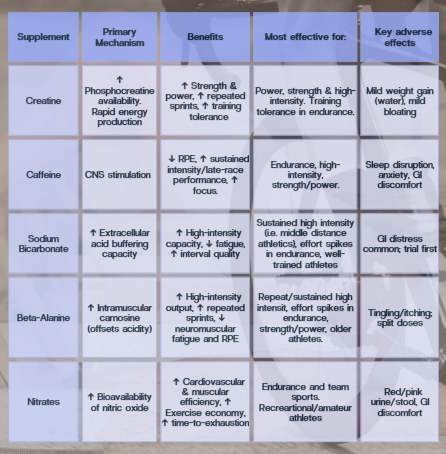
The supplements most consistently supported by sports nutrition research include:
Creatine: improves strength, power and repeated sprint ability
Caffeine: reduces perceived effort and improves endurance performance
Beta-alanine: buffers muscle acidity during high-intensity exercise
Sodium bicarbonate: improves tolerance to metabolic acidosis
Dietary nitrates: improves exercise efficiency in endurance events
Each supplement influences different physiological systems, meaning their benefits depend on the demands of the sport and the key performance limiter involved.
Practitioner Insight: Start with Nutrition, Not Supplements
In practice, the most common performance limiter seen in athletes is not a lack of supplementation, but suboptimal fuelling relative to training demands.
Insufficient carbohydrate availability, low energy intake, and inadequate recovery nutrition frequently underpin fatigue, impaired adaptation, and inconsistent performance.
Addressing these fundamentals will typically produce far greater performance benefits than introducing supplements. Ergogenic aids should therefore be viewed as a refinement strategy rather than a primary performance solution.
Under-fuelling and suboptimal core nutrition also increases the risk of gastrointestinal distress that is prevalent amongst endurance athletes. Supplement use can exacerbate this, with potential negative performance impact.
Before Using Sports Supplements
Before introducing any supplement, athletes should consider:
Is my overall nutrition already optimised?
Is there strong evidence supporting this supplement for my sport?
Do the potential benefits outweigh possible adverse effects?
Have I trialled this strategy in training before competition?
Many supplements offer little meaningful benefit. In some cases they may also cause gastrointestinal discomfort, sleep disruption, anxiety, or unnecessary financial cost.
A strategic, evidence-based approach is always preferable.
A Note on Energy Availability
Whilst relevant across all sports, in endurance sport particularly fatigue is often driven by low energy availability rather than the absence of supplements. When athletes maintain chronic low energy availability, performance, recovery, endocrine function and overall athlete health can be affected — potentially developing into the multi-system physiological condition known as Relative Energy Deficiency in Sport (REDs). In these situations, improving overall energy and carbohydrate intake will usually have a far greater impact on performance than introducing supplements.
How Athletes Actually Use Supplements
In practice, supplements are rarely used in isolation. Instead, they are typically integrated alongside structured training and fuelling strategies to address a specific performance limiter.
For example:
an endurance athlete struggling with late-race fatigue may trial caffeine
an athlete competing in events with repeated surges may consider beta-alanine
sports requiring repeated sprint efforts may benefit from creatine
The goal is not to use more supplements, but to ensure that supplementation strategies directly align with the physiological demands of the sport.
Creatine Monohydrate
What it does
Creatine increases intramuscular phosphocreatine stores, supporting rapid ATP regeneration during short, high-intensity efforts. In practical terms, this helps athletes produce high power repeatedly.
Typically most relevant in
strength and power sports
sprint events
team sports requiring repeated accelerations
Performance benefits
Research consistently demonstrates that creatine supplementation is associated with improvements in:
maximal strength
peak power output
repeated sprint performance
tolerance to high training volumes
Endurance relevance
Creatine does not improve steady aerobic performance. However, endurance athletes may benefit indirectly through improved sprint finishes, higher-quality interval training, and strength adaptations that support endurance performance.
Potential adverse effects
body mass increase (~1–2 kg) due to water retention
occasional bloating or gastrointestinal discomfort
Caffeine
What it does
Caffeine acts on the central nervous system by blocking adenosine receptors, reducing perceived effort and increasing alertness. In simple terms, exercise can feel easier at a given intensity.
Typically most relevant in
endurance events
team sports
combat sports
strength and power events
Performance benefits
Caffeine is one of the most consistently effective supplements in sports nutrition, with demonstrated benefits in:
time-trial performance
reaction time and vigilance
tolerance to fatigue
late-stage sprint capacity
Endurance relevance
Caffeine is particularly useful in endurance events where fatigue is driven by rising perceived effort later in competition.
Potential adverse effects
sleep disruption
anxiety or jitteriness
gastrointestinal discomfort
considerable individual variability in response
Beta-Alanine
What it does
Beta-alanine increases muscle carnosine levels. Carnosine acts as an intracellular buffer, helping manage hydrogen ion accumulation during high-intensity exercise. This helps delay the “burn” associated with sustained hard efforts.
Typically most relevant in
400–1500 m running
200–400 m swimming
rowing 2 km
repeated high-intensity efforts
Performance benefits
Evidence suggests beta-alanine may:
improve high-intensity exercise capacity
delay fatigue during repeated surges
enhance interval training quality
Endurance relevance
Beta-alanine does not increase VO₂max and has little impact on steady aerobic output. Its value lies in endurance events that include surges, climbs, or sprint finishes.
Potential adverse effects
tingling or itching sensation (paresthesia), usually harmless
can be reduced by splitting doses
Sodium Bicarbonate
What it does
Sodium bicarbonate increases extracellular buffering capacity, helping remove hydrogen ions from working muscle during intense exercise.
This improves tolerance to metabolic acidosis during high-intensity efforts.
Typically most relevant in
Efforts lasting approximately 30 seconds to 10 minutes.
Performance benefits
Research suggests sodium bicarbonate may improve:
sustained high-intensity output
repeated sprint performance
Endurance relevance
Most useful in middle-distance events, rowing, and high-intensity cycling time trials. Less relevant for steady endurance events.
Potential adverse effects
gastrointestinal distress
nausea or bloating
requires careful trialling during training
Dietary Nitrate
What it does
Dietary nitrate increases nitric oxide availability, improving blood flow and mitochondrial efficiency. This can reduce the oxygen cost of submaximal exercise, allowing athletes to maintain pace with slightly lower physiological strain.
Typically most relevant in
distance running
cycling
triathlon
Performance benefits
Dietary nitrate may improve:
exercise economy
time-to-exhaustion
some time-trial performances
Endurance relevance
This is primarily an endurance supplement. Benefits are most consistently observed in recreational and sub-elite athletes, with smaller effects in highly trained elite populations.
Potential adverse effects
mild gastrointestinal discomfort
red or pink urine/stool after beetroot products (harmless)
Practitioner Insight: Individual Responses Vary
Athlete responses to supplements can vary considerably. Differences in genetics, habitual caffeine intake, training status, gut tolerance, and competition demands all influence whether a supplement produces a meaningful performance effect.
For this reason, supplementation strategies should always be tested during training before being used in competition, allowing athletes to assess both performance response and potential adverse effects.
Selecting the Right Supplement: Identify the Key Performance Limiter
A useful approach to supplementation is to identify the key performance limiter in your event.
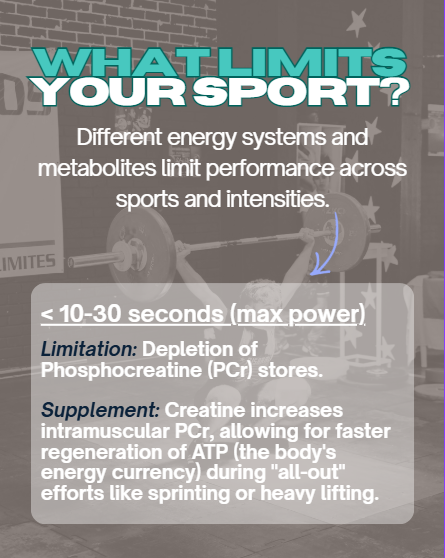
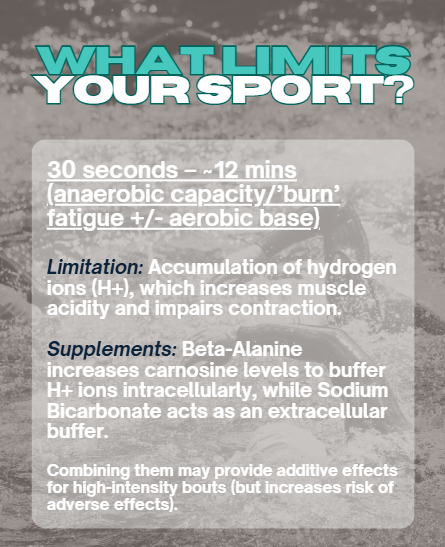
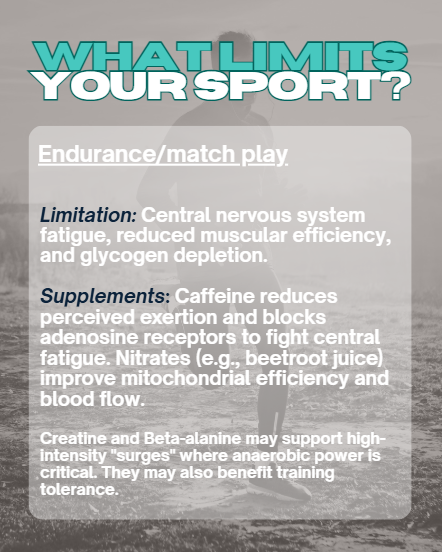
Not every athlete will benefit from supplementation, and the same supplement may not be appropriate in every training phase.
Download the Athlete Quick-Reference Guide
For a simplified overview of these supplements — including benefits, endurance relevance and potential adverse effects — download the quick-reference table below.
Download: Evidence-Based Sports Supplements Quick Reference
Key Takeaways
Only a small number of supplements have strong evidence supporting performance benefits.
The most consistently supported options include creatine, caffeine, beta-alanine, sodium bicarbonate and dietary nitrate.
Performance improvements are typically modest (around 1–3%), but may still influence competitive outcomes.
Supplements should only be considered after nutrition, training and recovery are well established.
The most effective approach is to match supplementation strategies to the key performance limiter in the sport.
Final Perspective
Evidence-based supplementation can provide small but meaningful performance benefits when applied appropriately.
However, supplements should never replace well-structured training, adequate energy availability, or a balanced diet. In many cases, addressing these fundamentals will have a far greater impact on performance than any individual supplement.
Where supplements are used, they should be selected according to the demands of the sport, trialled carefully in training, and considered alongside potential adverse effects and individual tolerance.
Athletes considering supplementation may benefit from individualised guidance to ensure strategies are evidence-based, safe, and aligned with the demands of their training and competition.
Athletes competing under anti-doping regulations should prioritise supplements that have undergone independent batch testing, for example through the Informed Sport, to reduce the risk of contamination with substances prohibited in sport.
Frequently asked questions
-
For supplements with the strongest evidence base, performance improvements are typically modest — often around 1–3%. However, in competitive sport even small improvements can influence outcomes when training, nutrition and recovery are already well optimised.
-
The supplements most consistently supported by research include:
creatine monohydrate
caffeine
beta-alanine
sodium bicarbonate
dietary nitrate (beetroot)
Each targets different physiological processes involved in performance, meaning their usefulness depends on the demands of the sport and the athlete’s key performance limiter.
-
Supplements can be useful for endurance athletes in certain contexts, particularly when targeting specific performance limiters such as perceived effort, exercise economy or high-intensity surges.
However, adequate energy intake, carbohydrate availability, and recovery nutrition remain far more influential for performance than supplementation alone.
-
Some supplements can cause adverse effects such as gastrointestinal discomfort, sleep disruption, or anxiety. Product quality can also vary.
Athletes competing under anti-doping regulations should prioritise supplements that have undergone independent batch testing, for example through the Informed Sport, to reduce the risk of contamination with prohibited substances.
-
No. Responses to supplementation vary considerably between individuals due to factors such as genetics, training status, habitual caffeine intake, gut tolerance and event demands.
For this reason, supplements should always be trialled during training before competition.
Author
Rachel Howarth
Sports Performance Dietitian — RJ Performance Nutrition
Rachel works with endurance athletes to develop evidence-based nutrition strategies that support performance, recovery, and long-term athlete health.
References
Burke, L. M., et al. (2019). Dietary supplements and the high-performance athlete. International Journal of Sport Nutrition and Exercise Metabolism, 29(2), 229–239.
Grgic, J., et al. (2020). Caffeine ingestion enhances endurance performance. British Journal of Sports Medicine, 54(11), 681–688.
Hobson, R. M., et al. (2012). Effects of beta-alanine supplementation on exercise performance. Amino Acids, 43(1), 25–37.
Kreider, R. B., et al. (2017). International Society of Sports Nutrition position stand: Creatine supplementation. Journal of the International Society of Sports Nutrition, 14(1), 18.
McMahon, N. F., et al. (2017). Dietary nitrate supplementation and endurance performance. Sports Medicine, 47(3), 471–481.
Peeling, P., et al. (2018). Evidence-based supplements for the enhancement of athletic performance. International Journal of Sport Nutrition and Exercise Metabolism, 28(2), 178–187.